180° · STORIES, MAPS AND DOCUMENTS
History of the
International Date Line.
Have you noticed the line that zigzags across the Pacific on many maps and globes?
WHAT IT IS
It is the International Date Line.
An imaginary line separating two consecutive dates. Cross it westward and the calendar moves forward a day; cross eastward and it moves back.
WHY IT ZIGZAGS
Countries have helped shape it.
Its reference is the 180° meridian, opposite Greenwich. But it bends to keep countries and island groups on the same calendar date. Here you can discover how it has changed and why.
How the Date Line changed shape
These drawings summarise eleven stages of the line. They are provisional reconstructions, not period maps. The straight 180° line is a reference for comparison. Select an outline to see its sources and what each source tells us.
Where to start
Start with what interests you most.
EXPLORE THE MAP
How the line has changed.
Move the slider to choose a period and see the line on the map. The note below tells you what happened and which source records it.
1995–2011 · Kiribati
Provisional reconstruction. Open the explorer to consult the sources.
Explore the map in detail →1995–2011
About this map and its sources
The red line is a provisional reconstruction, not an official border. The coastlines come from Natural Earth and are in the public domain.
For Kiribati, we use the IANA time-zone database, which dates the skipped day in Kanton and Kiritimati to 31 December 1994. How the change took effect locally during January 1995 remains uncertain. We also use later maps to draw the line.
01 · UNDERSTAND THE LINE
From Thursday to Friday
across the line.
Cross westward and you add a day to the calendar. Cross eastward and you subtract a day. In this example you cross westward, from Thursday 29 to Friday 30.
What does Greenwich have to do with it? →The example shows the date change at the crossing, without counting travel time.
Stories from the Date Line
All stories and topics →2011
The Friday Samoa skipped
What happened to wages for a day that did not exist?
Read the story →1844
The Philippines went from Monday to Wednesday
An order removed Tuesday, 31 December 1844 from the calendar.
Read the story →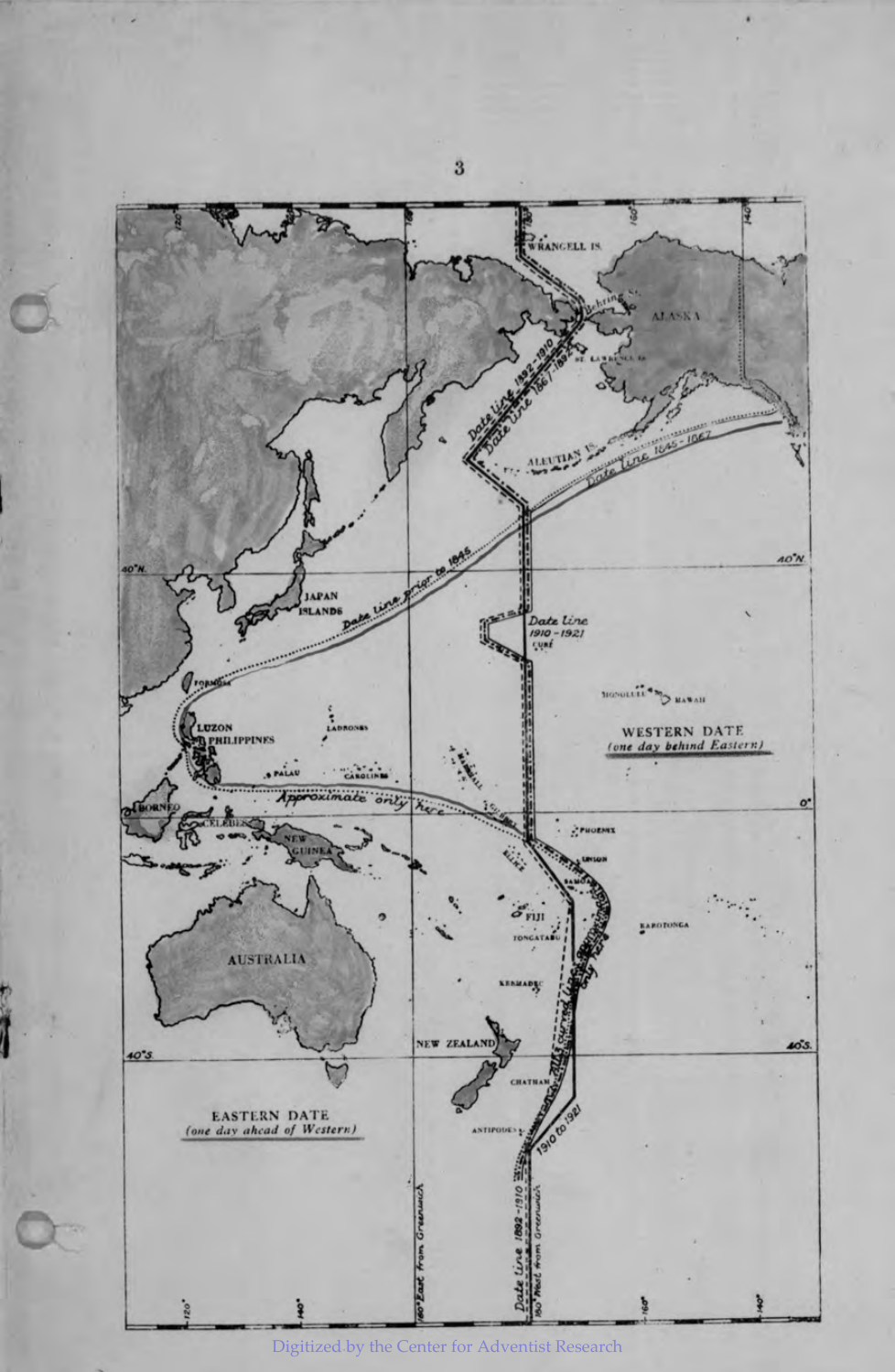
1910
The islands that vanished from the map
Why Morrell and Byers disappeared, along with a bend in the Date Line.
Read the story →
1995
One country, two different dates
The islands began sharing the same calendar date, while keeping different local times.
Read the story →ONE MORE QUESTION
Could a ship have its bow on Sunday and its stern on Saturday?
Discover the answer
Yes, as a way to explain the line. In a book published in 1629, Nicolas Bergier imagined the front of a ship in one day and the back in the previous day. He was describing an example, not a real voyage.
Bergier, Le point du iour, 1629 · pp. 227–228 ↗